
Water and Carbon Cycles
The Carbon Cycle
The carbon cycle is one of the most essential systems on Earth. It describes how carbon moves between the atmosphere, hydrosphere, biosphere, lithosphere and cryosphere, regulating climate, supporting life, and shaping long-term environmental change. Although carbon stores vary significantly in size, they are all interconnected through a series of flows operating over very different timescales.
At the global scale, the carbon cycle operates as a closed system; carbon is recycled within the Earth with almost no significant inputs or outputs. However, within this closed framework, individual subsystems such as the atmosphere, oceans, biosphere and lithosphere function as open systems, constantly exchanging carbon through a range of flows.
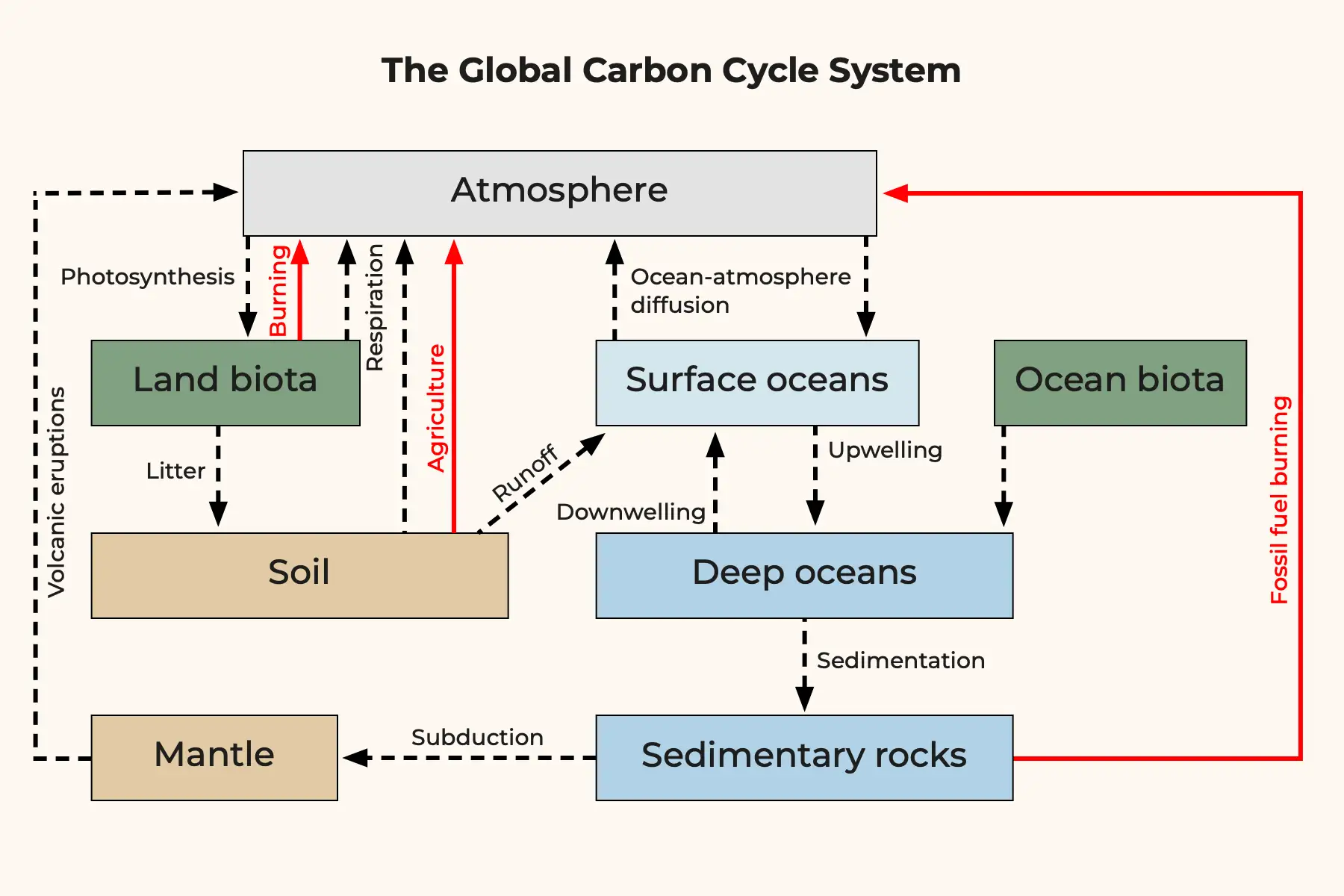
The Global Carbon Cycle System
What is the Carbon Cycle?
The carbon cycle is the continuous movement of carbon through Earth’s major subsystems:
- Atmosphere
- Biosphere
- Hydrosphere
- Lithosphere
- Cryosphere
Carbon moves between these stores via both fast biological processes (such as photosynthesis and respiration) and slow geological processes (such as weathering and sediment formation).
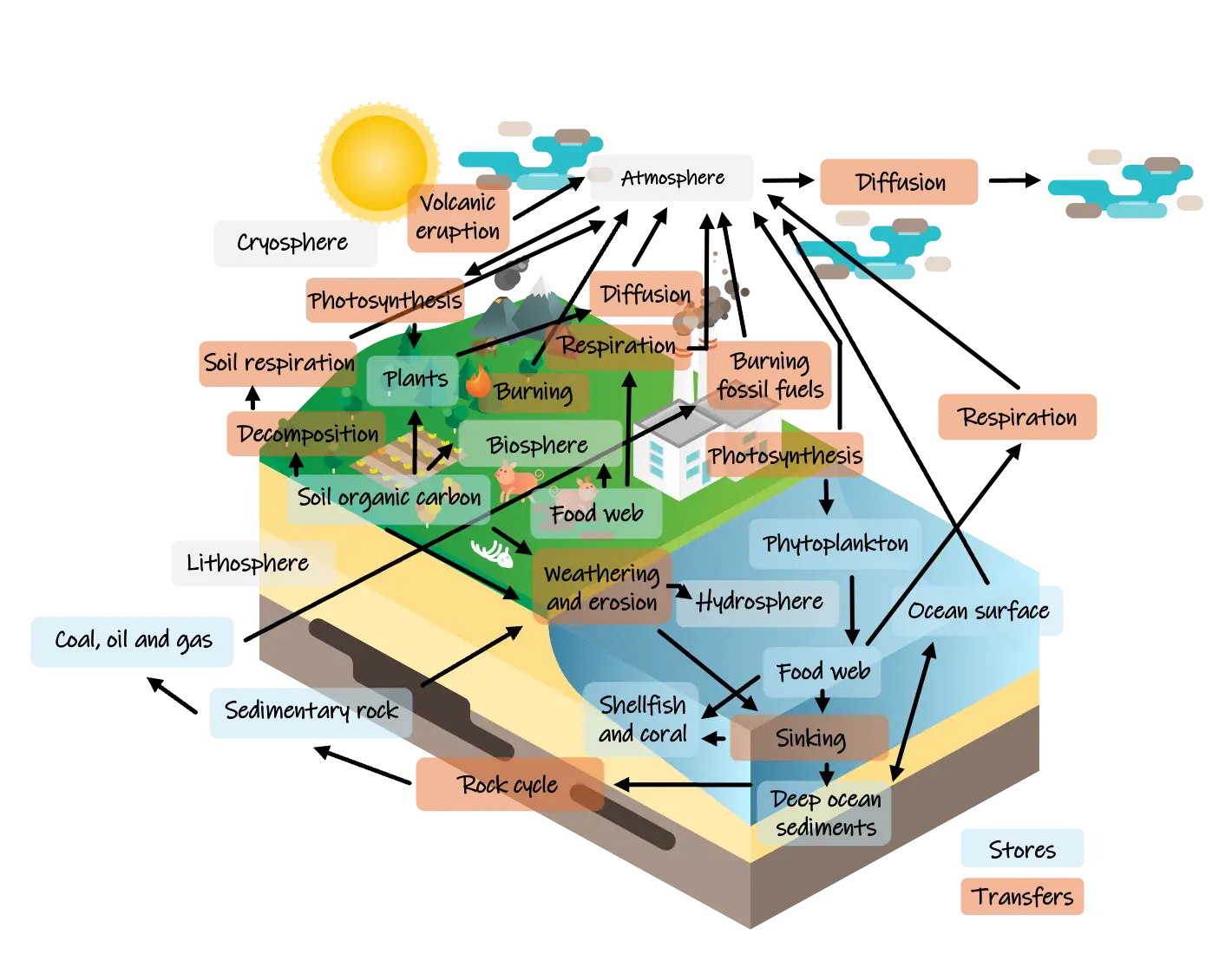
The Carbon Cycle
Together, these processes keep carbon cycling through the planet and help regulate Earth’s climate over timescales ranging from seconds to millions of years.
Major Stores of Carbon
Lithosphere – the largest store (~99.9% of global carbon)
Found in rocks, sediments, fossil fuels and soils.
Includes long-term geological stores formed through burial and sedimentation.
Residence times can exceed millions of years.
Hydrosphere – oceanic carbon (~0.04%)
- Carbon is stored as dissolved CO₂, bicarbonate and carbonate ions.
- The surface ocean exchanges CO₂ rapidly with the atmosphere.
- Deep ocean stores carbon for centuries to millennia.
Cryosphere – frozen stores (~0.01%)
- Carbon is locked in permafrost and frozen soils.
- Sensitive to climate change: thawing releases CO₂ and methane.
Biosphere – living and dead organic matter (~0.004%)
- Carbon is stored in vegetation, soils, peat, plankton and organic debris.
- Stores vary with climate, vegetation type and land use.
Atmosphere – smallest active store (~0.001%)
- Mainly CO₂ and CH₄.
- Small in size but significant in its influence on the greenhouse effect and global temperature.
Did you know?
Even though the atmosphere contains less than 0.001% of Earth’s carbon, small changes in atmospheric CO₂ have a significant impact on global temperature. That’s because greenhouse gases trap outgoing heat, meaning even tiny increases can amplify warming across the whole climate system.
Key Carbon Flows
Carbon moves between stores through a combination of biological, chemical and physical processes.
Fast Biological Flows (seconds → years)
Photosynthesis
Plants and phytoplankton absorb CO₂ from the atmosphere and convert it into organic matter (biomass). This is the primary input from the atmosphere → biosphere.
Respiration
Plants, animals and microbes release CO₂ back into the atmosphere as they break down sugars for energy.
Decomposition
When organisms die, decomposers break down organic matter, releasing carbon into soils and the atmosphere (CO₂ and CH₄).
Combustion
Burning biomass (wildfires) and fossil fuels rapidly transfer carbon to the atmosphere.
Slow Geological Flows (centuries → millions of years)
Weathering
Carbonic acid (CO₂ + water) dissolves rocks, transferring carbon from the atmosphere to rivers and the ocean.
Sedimentation & Burial
Organic carbon and carbonates accumulate on ocean floors and form sedimentary rock.
Tectonics & Volcanic Outgassing
Subducted rocks melt and can release CO₂ through volcanic eruptions.
Ocean Carbon Processes
The oceans play a critical role in moving and storing carbon:
Solubility Pump
Cold water absorbs CO₂ more effectively. Carbon is transported by currents and released as water warms.
Biological Pump
Phytoplankton absorb CO₂; when they die, some carbon sinks to the deep ocean.
Carbonate Pump
Marine organisms use dissolved carbon to build shells and skeletons. When they die, these settle to the bottom as carbonate sediments.
Scales and Timescales of Carbon Cycling
Carbon flows operate simultaneously across multiple scales:
Plant Scale (hours–years)
- Photosynthesis, respiration and litterfall.
- Seasonal shifts in carbon uptake.
Sere (Ecosystem) Scale (years–centuries)
- As ecosystems develop through succession, biomass and soil carbon typically increase.
- Disturbances (fire, storms) release carbon back to the atmosphere.
Continental / Global Scale (centuries–millennia)
- Ocean circulation patterns redistribute dissolved carbon.
- Glacial–interglacial cycles change atmospheric CO₂ levels.
- Geological sequestration stores carbon over millions of years.
What Drives Change in Carbon Stores?
Natural Factors
- Temperature changes – affect photosynthesis, respiration and decomposition.
- Wildfires – release carbon rapidly; regrowth can increase future sequestration.
- Volcanism – adds CO₂ to the atmosphere.
- Climate change – warmer conditions deepen the permafrost active layer, releasing more CH₄ and CO₂.
- Ocean temperature – warmer oceans hold less dissolved CO₂.
Human Factors
Human activity has altered the carbon cycle more in the last 200 years than natural processes have in thousands.
Fossil Fuel Combustion
Releases large quantities of CO₂, increasing atmospheric concentrations and warming the climate.
Deforestation
Reduces biosphere carbon stores and removes vegetation that would otherwise absorb CO₂.
Agriculture & Land-Use Change
Soil disturbance releases stored carbon; cattle farming increases methane emissions.
Urbanisation
Seals soils, reduces vegetation cover and transforms natural carbon pathways.
Carbon Sequestration (Positive Intervention)
- Reforestation and afforestation
- Peatland and wetland restoration
- Carbon Capture and Storage (CCS)
- These strategies aim to increase long-term carbon storage.